
The "caution level" among the troops has also been raised.

'The muscularity of the last three years didn't bring any dividends and if anything, Chinese attitudes only hardened,' says Ambassador M K Bhadrakumar.

Spokesperson in the MEA Anurag Srivastava said both sides have agreed to work for an early resolution to the issue in keeping with broader guidance provided by leaders of the two countries for ensuring peace and tranquillity along the border areas. He, however, did not respond to questions relating to reports of pulling back of troops by both India and China from certain friction points in the Galwan Valley and Hot Spring areas in eastern Ladakh in the last few days.

China does not have to give up what it took in 2020, it will never give up its claim to Arunachal Pradesh, Ladakh and other areas, and it has all the time now to plan its next surprise, points out Lieutenant General Prakash Katoch (retd).

United States Secretary of State Antony Blinken has said that he had a productive meeting with visiting External Affairs Minister S Jaishankar during which they discussed the bilateral ties, COVID-19 relief efforts, India-China border situation and Afghanistan and vowed to work together to address areas of shared concern.

China on Thursday tried to play down the continuing border standoff at Chumar coinciding with the visit of President Xi Jinping to India, saying the incident has been "effectively controlled and managed".

The draft will be examined, studied and discussed before it is tabled in the assembly on February 6, he said.

'Russia remains in a unique position since it has special strategic relations with both India and China and these relationships are independent in nature'
'My understanding is that by the time President Xi Jinping came for the Chennai summit [2019], he had already instructed his army to undertake the action in Galwan in the summer of 2020.'

'These tactics are particularly evident in China's pursuit of its territorial and maritime claims in the South and East China Seas as well as along its border with India and Bhutan'
The US has all along interfered in India-China issues. The objective is clear: Bring the Sino-Indian standoff to a flashpoint that would compel Modi government to take shelter under an American umbrella, argues Ambassador M K Bhadrakumar.
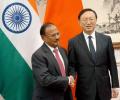
'Russian diplomacy is presumably at work.' 'The ground is slippery, because "territorial sovereignty" is a hugely sensitive issue,' says Ambassador M K Bhadrakumar.

Chinese President Xi Jinping, who made a rare visit this week to the restive Xinjiang region which borders Ladakh, met the troops and officers stationed there and praised their "outstanding contributions" to the border defence and stabilisation of the volatile province.

"India and China are in communication and negotiations on lowering the temperatures through military and diplomatic channels. No party should engage in any action that may escalate the situation at this point," Chinese Foreign Ministry spokesperson Zhao Lijian said during a briefing when asked about the Prime Minister's visit.

Ahead of the 50th anniversary of the 1962-war, China on Friday said that it "wholeheartedly" wishes to solve the border dispute with India through negotiations and maintain a friendly relationship. "China develops in a peaceful way wholeheartedly, and hopes to maintain a friendly and cooperative relationship with India. China wishes to settle boundary issues through negotiations wholeheartedly," Chinese foreign ministry spokesman Hong Lei said.
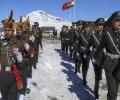
With regard to where relations between New Delhi and Beijing stand, the Union minister said that he does not have a definite answer to offer at "this moment".

The formal process of disengagement of troops began on July 6, a day after a nearly two-hour telephonic conversation between National Security Advisor Ajit Doval and Chinese Foreign Minister Wang Yi on ways to bring down tensions in the area.

"I am saddened, however, that there is a small, handful of members that seem to be still tolerating the war," Sergiy Kyslytsya said after the Security Council voted on the United States-led draft resolution.

At an online media briefing, External Affairs Ministry Spokesperson Anurag Srivastava gave a run down of the events along the LAC in the eastern Ladakh region and held China responsible for the Galwan Valley clashes off June 15.

Jaishankar described as a "reasonable supposition" to expect some improvement in the relations between India and China following the last round of disengagement but hesitated to say that there could be a reset of the ties.

'At critical moments an inability to take tough decisions resulted in potentially far-reaching solutions slipping out of our grasp.' 'If similar opportunities come Narendra Modi's way will he act differently?' asks Karan Thapar.
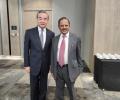
National Security Advisor Ajit Doval held a meeting with top Chinese diplomat Wang Yi during which he emphasised the need for continuing efforts to restore peace and tranquillity in the border areas to remove the 'impediments' to normalcy in bilateral relations.

External Affairs Ministry spokesperson Randhir Jaiswal said India is closely monitoring the security situation in that country.

The Centre on Tuesday told the Supreme Court that China has made a huge build-up in the Tibet region and the Army needs broader roads to move heavy vehicles up to the India-China border to avoid a 1962 war-like situation.
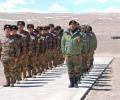
The last contact between India and China was the military talks at the Corps Commander level in October this year.

The elephant in the room will permeate the conversations, predicts Rup Narayan Das.
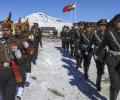
The decision to disengage the forces, locked in a bitter standoff for the last six weeks in eastern Ladakh, was taken at a nearly 11-hour-long meeting between senior Indian and Chinese commanders in Moldo on the Chinese side of the Line of Actual Control (LAC) on Monday.

The Wednesday talks took place amid a war of words between the two sides on perception of the LAC, the de-facto Sino-India border spanning a length of nearly 3,500 km.
"On the border issue, China always maintains that we should follow through on treaties and agreements we signed and we jointly uphold peace and tranquility at the border region," Foreign Ministry spokesman Wang Wenbin said while responding to Jaishankar's remarks.
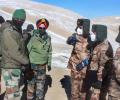
In the fresh round of talks, the Indian side is expected to press for disengagement of troops as soon as possible in all the remaining friction points besides seeking resolution of issues in Depsang Bulge and Demchok.
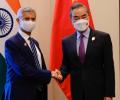
India and China are likely to hold the 16th round of high-level military talks on July 17 to resolve the issues in remaining friction points along the Line of Actual Control (LAC) in eastern Ladakh, people familiar with the development said on Wednesday.

The last meeting between the two sides at the Corps Commander level was held in December last year.

The sources said the situation in eastern Ladakh remained 'tense' and that around 30-40 soldiers of China's People's Liberation Army (PLA) are holding up at a position close to an Indian post in the Rezang-La ridgeline in eastern Ladakh.

Prime Minister Modi and President Xi held the conversation on Wednesday on the sidelines of the BRICS (Brazil, Russia, India, China, South Africa) summit in Johannesburg.

'Vijay Gokhale's appointment as foreign secretary can be regarded as a certain 'adjustment' that could make a difference to the poor climate of India-China relations,' says Ambassdor M K Bhadrakumar.
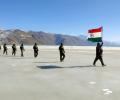
Indian troops are defending every inch of the border with China and not even a single inch of land has been taken over by the neighbouring country in recent years, Ladakh Lt Governor Brig (retd) B D Mishra said on Thursday.

The former Congress president has been questioning the government over the martyrdom of Indian soldiers and has demanded answers from the prime minister.

It is for China to decide what role it plays at the G20 summit in New Delhi, a top US official has said, asserting that if Beijing wants to come in and be a "spoiler", that option is available to it.
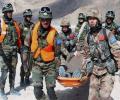
The day-long exercise held "is part of the ongoing initiatives being taken by India and China to ensure greater interaction between troops stationed along the Line of Actual Control.
Foreign Secretary Harsh Vardhan Shringla terms India's relationship with China as "complex".
